

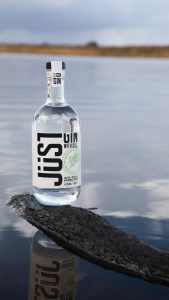
Lake Vättern is the second largest freshwater lake in Sweden and the sixth largest lake in Europe. Famous for the purity of its transparent water, Vättern is our water source for making JÜST dill gin.
Naturally we’re proud of this fact and we believe that to produce a high quality spirit, the ingredients should also be of the highest possible quality. It just makes sense to us!
But there are mixed opinions on the importance of water quality when it comes to spirit production. Does the water source really matter or is it just another opportunity for marketeers to romanticise their ‘spirit made with 300 year old droplets filtered through ancient rock?’!
We consider the evidence… 🙂
For hundreds of years, whiskey makers have gone to great lengths to find the best water sources to build their distilleries. The quality of the water has always been a key element in whiskey production and you’ll find the vast majority of the world’s whiskey distilleries located near natural water sources.
In Kentucky, world famous for its bourbon, the mineral rich limestone water naturally filters out certain unwanted compounds and balances the pH levels, which plays a key role in the distillation process. If you visit a distillery in Kentucky, it’s most key that “limestone” will be prominent in that whiskey’s brand story.
Water also plays a very important role in the making of vodka. It’s name even stems from the Russian word for water ‘voda’. Vodka should be completely colourless – just like water – and as odourless as possible. Distillers will use the purest water available to get the vodka crystal clear. So vodka makers, like whiskey makers, are always on the search for pure water sources.
But as most consumers are aware, a product truth can often be stretched somewhat, for the sake of a good marketing story. A well know Scottish whiskey produced in the highlands used to tell the story of its water having run through hills of heather into a loch before being distilled. Giving the whiskey it’s heathery taste. A good story, but not true in the sense that the water contributed to the whiskey’s flavour.
To test the impact of water quality on the quality of gin, a group of distillers from the American Distillers Institute made the same gin six times. They started with the same neutral grain spirit, flavoured it with the same botanicals and used the same pot still. The only thing they varied was the water.
Putting their highly tuned tastebuds to the test, they concluded that the French water was “soft and clean” The Icelandic water had “a very short flavour profile” and “a cloying texture.” And the tap water, ”Full-bodied, with a smooth texture that really fills the mouth,” They didn’t claim the differences were huge, but they did claim they were there.
We’re talking about barely-noticeable differences here. You’re not going to nose JÜST dill gin and think ‘Ah, undeniably freshwater from Götaland South Sweden’ (though we’d be incredibly impressed if you did) But the quality of water IS important, as is the sustainability of the production process.
It may not have a noticeable affect on the flavour of the gin, that’s down to the fresh botanicals (and that’s for another post). But we do believe that using some of the world’s freshest water contributes to the smoothness of our gin. And we have lake Vättern to thank for that.
